


Stock Code
002255




In a refinery, recovering heat from hot process gas can significantly improve the overall energy balance. However, not all waste heat boilers are designed for the same operating environment. This is especially important in Fluid Catalytic Cracking (FCC) units, where high-temperature flue gas can contain catalyst particles, carbon monoxide, corrosive components, and significant thermal energy.
This raises an important engineering question: Can a standard waste heat boiler handle FCC flue gas, or does an FCC unit require a high-temperature waste heat boiler specifically designed for the process?
In most cases, the answer depends on the actual gas conditions, heat load, pressure requirements, and operating pattern. The key difference is not simply the maximum temperature of the boiler, but how the entire heat recovery system responds to the demanding FCC environment.
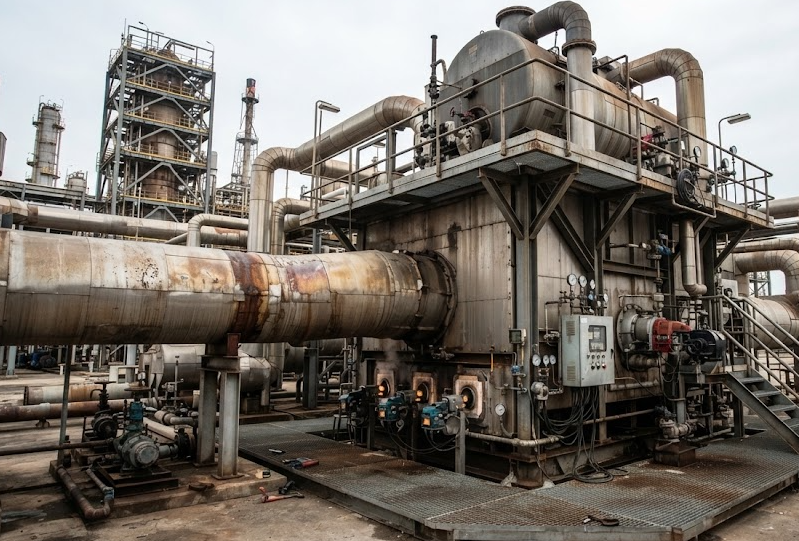
FCC regeneration produces high-temperature flue gas that carries substantial recoverable energy. A properly designed FCC Waste Heat Boiler can transfer this energy to water and generate useful steam for refinery processes or power generation.
However, FCC flue gas is not a clean heat source.
Catalyst particles carried by the gas can create erosion on heat-transfer surfaces. Gas composition can also introduce corrosion and fouling concerns, while rapid changes in temperature and flow can create thermal stress.
A standard waste heat boiler designed for a relatively clean and stable gas stream may therefore require significant modification before it can operate reliably in an FCC application.
| Factor | High Temperature FCC Waste Heat Boiler | Standard Waste Heat Boiler |
| Gas condition | Designed around FCC flue gas characteristics | Usually designed for a defined industrial gas source |
| High-temperature operation | Specifically engineered for demanding FCC conditions | Depends on the original application |
| Catalyst erosion | Requires dedicated erosion-control measures | May not be optimized for catalyst-laden gas |
| Thermal cycling | Designed to accommodate process temperature changes | Depends on boiler structure and application |
| Steam generation | Often designed for high-pressure refinery steam | Depends on process requirements |
| CO handling | Can be integrated with CO combustion/recovery systems | Not necessarily designed for CO-rich FCC gas |
| Engineering approach | Process-specific | More standardized |
The comparison shows why selecting a boiler simply according to gas temperature can be misleading.
The gas composition, particle loading, velocity, pressure, heat-release pattern, and required steam conditions are equally important.
One of the most important differences between FCC service and many conventional waste heat applications is catalyst erosion.
Fine catalyst particles carried by high-velocity flue gas can continuously impact heat-transfer surfaces. Over a long operating period, this may cause tube-wall thinning, leakage, and unplanned shutdowns.
Hailu Heavy Industry specifically identifies catalyst erosion as a major challenge in FCC waste heat recovery. Its FCC boiler designs use controlled gas-flow arrangements and protective measures in exposed areas to reduce the impact of abrasive particles on critical components.
This is an important distinction between a general-purpose waste heat boiler and an FCC-specific waste heat recovery boiler.
A high-temperature boiler cannot be made reliable simply by selecting materials with a higher temperature rating.
The complete structure must accommodate thermal expansion and contraction.
FCC operating conditions can change during start-up, shutdown, load variation, and process disturbances. If different components expand at different rates while the structure is too rigid, thermal stress can accumulate around tubes, supports, headers, and connections.
Hailu's FCC waste heat boiler designs include full-hanging or floating structural concepts that allow internal components to expand and contract more freely as temperature changes. This approach is intended to reduce excessive thermal stress and improve long-term mechanical reliability.
Therefore, when comparing high temperature waste heat boilers, buyers should evaluate the thermal-expansion design rather than looking only at the rated operating temperature.
FCC flue gas may contain carbon monoxide, which represents both an energy opportunity and an environmental consideration.
A properly engineered CO waste heat boiler can use controlled combustion to convert CO into CO₂ while releasing additional heat. That heat can then contribute to steam generation.
This means the system is not simply recovering sensible heat from exhaust gas. It can also recover chemical energy contained in combustible components of the gas.
Hailu's FCC projects include both natural-circulation and supplementary-fired configurations. Its published project data includes FCC waste heat boilers producing approximately 125–156 t/h of steam, with rated steam pressures and temperatures varying according to the specific refinery project.
This illustrates an important point: FCC waste heat boiler design must be based on the complete process conditions rather than a standard boiler template.
The purpose of heat recovery is not simply to reduce exhaust temperature. The recovered heat must produce steam that can actually be used by the refinery.
Depending on the refinery's steam balance, the boiler may be designed to produce medium- or high-pressure steam for process heating, turbine drives, or other utility requirements.
Hailu's published FCC references include examples with steam pressures ranging from around 3.8 MPa to 9.8 MPa and steam temperatures from approximately 410°C to 530°C.
These differences demonstrate why an FCC waste heat boiler manufacturer needs to design around the refinery's actual steam system.
The correct question is not simply “How much heat can the boiler recover?” but also “What steam conditions can the refinery use efficiently?”
A standard waste heat boiler can be appropriate when the waste-gas conditions are relatively stable and fall within the design range of the equipment.
For example, if the gas has predictable temperature, flow, composition, dust concentration, and pressure, a standardized design may provide an economical solution.
But an FCC unit should not be treated as a generic high-temperature exhaust source.
Before selecting a boiler, engineers should evaluate:
● Flue gas temperature and flow rate
● Catalyst particle concentration
● Gas composition
● CO concentration
● Corrosive components
● Fouling tendency
● Required steam pressure and temperature
● Start-up and shutdown conditions
● Thermal cycling
● Available installation space
These parameters determine whether a conventional design is adequate or whether a dedicated FCC configuration is required.
Hailu Heavy Industry's business extends beyond individual boiler fabrication. The company provides waste heat and residual heat utilization solutions covering design, installation, operation, and EPC of complete waste heat recovery plants. Its product portfolio includes FCC waste heat boilers for petrochemical and refinery applications as well as systems for steelmaking, non-ferrous metallurgy, hydrogen production, sulfur units, reheating furnaces, and other industries.
This broader engineering capability matters because an FCC waste heat boiler is part of a process system. Boiler performance depends on the upstream flue-gas conditions, downstream gas treatment, steam system, circulation arrangement, and plant operating strategy.
So, High Temperature FCC Waste Heat Boiler vs. Standard Waste Heat Boiler: which is better for FCC units?
A standard waste heat boiler may work when the process conditions are mild and well defined. However, FCC applications generally require much more attention to catalyst erosion, thermal stress, high-temperature operation, gas composition, CO combustion, fouling, and steam conditions.
For a refinery operating under demanding FCC conditions, a process-specific high-temperature FCC waste heat boiler can provide a more appropriate engineering solution than adapting a general-purpose waste heat boiler.
The best selection should therefore begin with the actual FCC flue-gas data and refinery steam requirements. Once these conditions are understood, the boiler structure, materials, circulation system, heat-transfer surfaces, and protective measures can be designed around the process.
That is the difference between simply recovering waste heat and building a reliable FCC waste heat recovery system for long-term refinery operation.