


Stock Code
002255




In large-scale petroleum refining, the Fluid Catalytic Cracking (FCC) unit is the primary economic engine of the facility, converting heavy atmospheric residues into high-value transport fuels and petrochemical feedstocks. However, the FCC process is inherently energy-intensive and produces massive volumes of high-temperature flue gas laden with catalyst fines, carbon monoxide (CO), and sulfur oxides. For Engineering, Procurement, and Construction (EPC) contractors, maximizing refinery thermal efficiency while meeting strict environmental emissions standards depends on one critical piece of equipment: the FCC Waste Heat Boiler (also known as a CO Boiler or Flue Gas Energy Recovery Boiler).
During a multi-billion-dollar refinery construction or modernization campaign, selecting the right FCC waste heat boiler manufacturer for EPC projects is a high-stakes decision. The boiler must operate continuously for up to five years without unscheduled shutdowns, withstand extreme catalyst abrasion, and interface perfectly with complex modular plant configurations.
As a premier global authority in heavy industrial thermal equipment manufacturing, Hailu Heavy Industry engineers custom, high-durability heat recovery architectures that mitigate EPC execution risks while optimizing long-term refinery operational efficiency.
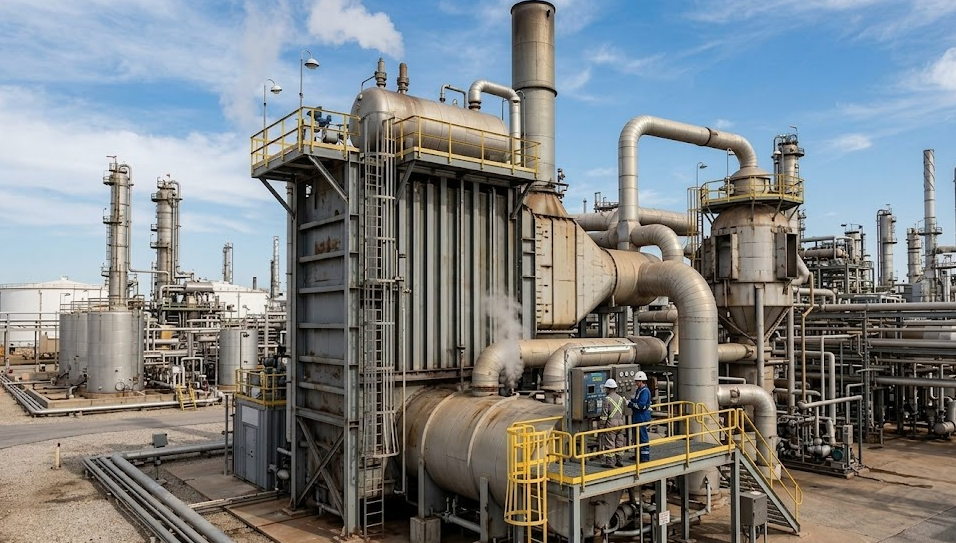
To accurately vet an industrial FCC CO boiler supplier, an EPC engineering team must look past generic boiler designs. Standard waste heat recovery units (WHRUs) quickly fail when exposed to the distinct thermodynamic and chemical environment of an FCC regenerator exhaust stream.
● Catalyst Fine Erosion: The flue gas carries highly abrasive micro-spherical catalyst particles (zeolite/alumina). At high velocities, these particles act as sandblasting media, rapidly eroding boiler tubes. An expert manufacturer must utilize specific velocity-controlled thermal designs and apply specialized hard-facing coatings, such as tungsten carbide or Inconel cladding, to vulnerable heat transfer zones.
● High-Temperature CO Combustion: If the regenerator operates in partial combustion mode, the flue gas contains substantial carbon monoxide. The waste heat boiler must feature an integrated, refractory-lined combustion chamber capable of safely incinerating CO at temperatures exceeding 950°C, converting chemical energy into high-pressure superheated steam.
● Dew Point Corrosion: As flue gas cools through the economizer section, sulfur oxides (SOX) risk condensing into sulfuric acid. The manufacturer must design precision feedwater preheating loops to keep tube metal temperatures strictly above the acid dew point, preventing catastrophic localized corrosion.
When an EPC firm evaluates an FCC flue gas energy recovery boiler manufacturer, engineering capabilities and design flexibility are just as critical as manufacturing capacity. The technical evaluation should prioritize several specialized competencies.
Before a single sheet of steel is cut, the manufacturer must execute comprehensive 3D CFD and thermal-hydraulic modeling. This modeling ensures uniform flue gas distribution across the tube banks, eliminates localized high-velocity channels that cause rapid erosion, and guarantees complete CO destruction inside the furnace chamber. Hailu Heavy Industry integrates advanced simulation protocols into every project, verifying thermal performance metrics prior to physical fabrication.
Operating under intense cyclic thermal expansion requires flawless mechanical design. Tube-to-tubesheet joints, membrane walls, and suspension systems must be designed using Finite Element Analysis (FEA) to withstand severe thermal shock during refinery start-up and shutdown phases. Sourcing a custom heavy duty refinery waste heat boiler ensures that all materials—from high-temperature alloy steels (like P11, P22, and P91) to structural supports—are specified to prevent creep rupture and thermal fatigue.
EPC schedules are exceptionally tight. A manufacturer must possess the facilities to assemble large-scale boiler modules—including integrated convection banks, steam drums, and piping headers—in-shop. Delivering fully hydro-tested, large-scale modules dramatically slashes on-site construction hours, reduces hot-work welding risks in the field, and ensures factory-controlled weld quality.
Sourcing critical-path equipment from an unverified vendor frequently introduces major supply chain vulnerabilities, lead-time delays, and regulatory headaches during plant commissioning.
A truly reliable refinery waste heat boiler engineering partner must hold comprehensive international certifications, including ASME (S, U, U2 stamps), National Board (NB) registration, and relevant regional standards like the European PED or localized environmental compliance codes.
By partnering with an established industrial titan like Hailu Heavy Industry, EPC contractors secure a fully supervised manufacturing workflow. With rigorous Non-Destructive Testing (NDT)—including 100% radiographic and ultrasonic inspection of high-pressure weld lines—contractors eliminate the risk of field weld failures. This stringent oversight protects the project from expensive structural re-work and ensures smooth regulatory approvals, keeping the final refinery commissioning timeline securely on schedule.
Selecting an FCC waste heat boiler manufacturer for EPC projects is a decision that impacts both the immediate execution of a construction contract and the next twenty years of a refinery's operational viability. By prioritizing advanced CFD erosion modeling, modular fabrication capability, and verified international quality compliance, EPC firms can confidently eliminate critical path risks. With the advanced metallurgy, structural engineering expertise, and massive global delivery footprint of Hailu Heavy Industry, your project secures the ultimate standard in industrial energy recovery—maximizing refinery uptime, lowering emissions, and boosting global supply chain efficiency.