


Stock Code
002255




Fluid catalytic cracking (FCC) units are the thermal heart of modern refineries, converting heavy vacuum gas oil into high-value gasoline and light olefins. The regenerator section burns coke off spent catalyst at temperatures reaching 650–720°C, producing a flue gas stream laden with carbon monoxide (CO), catalyst fines, sulfur oxides (SOx), and substantial sensible heat. An FCC flue gas waste heat boiler does not merely cool this stream—it transforms a hazardous effluent into a productive thermal asset. Hailu Heavy Industry engineers its FCC flue gas waste heat recovery boilers around a fundamental reality: the gas is not clean fuel. It is a corrosive, particulate-laden, variable-composition stream that demands metallurgical precision, advanced combustion control, and robust fouling management.
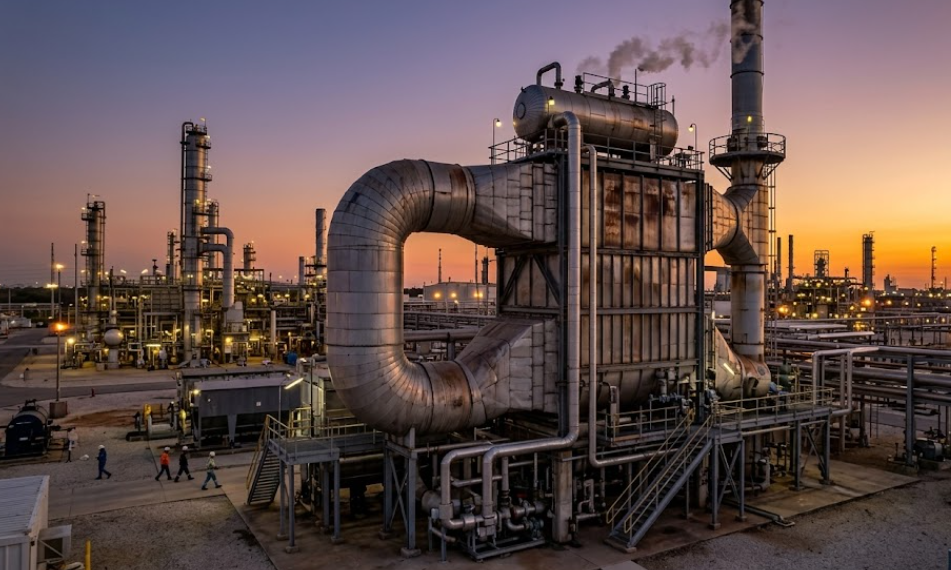
Traditional FCC installations employed separate CO boilers to combust regenerator off-gas before sending it to a waste heat boiler. Hailu Heavy Industry's integrated FCC flue gas waste heat boiler eliminates this redundancy by embedding a refractory-lined combustion chamber upstream of the heat recovery surfaces. The regenerator flue gas enters through multi-point injection ports designed to achieve turbulent mixing with combustion air, ensuring complete CO oxidation to CO₂ at temperatures above 850°C—well beyond the auto-ignition threshold of all combustible constituents. This integrated architecture serves two purposes: it destroys toxic CO to meet environmental regulations, and it elevates the gas temperature to maximize heat flux into the downstream steam generation sections.
The combustion chamber refractory is specified for erosion resistance and thermal shock tolerance. Catalyst fines entrained in the flue gas stream travel at high velocity; improper refractory selection leads to sulphuric acid corrosion of the steel shell and rapid material loss in the primary combustion zone. Hailu Heavy Industry selects high-alumina, erosion-resistant castable refractories with low thermal conductivity, protecting the pressure boundary while maintaining the internal temperature profile required for complete combustion.
Downstream of the combustion chamber, the flue gas enters the heat recovery train, typically configured as a water-tube boiler with forced circulation. Hailu Heavy Industry's FCC flue gas waste heat recovery boiler employs a modularized, vertical upward hot gas flow arrangement comprising three distinct heat transfer zones:
● Radiant/High-Temperature Evaporator Section: Membrane water-cooled furnace panels with inlet and outlet headers absorb radiant heat from the post-combustion gas stream. The tube spacing and fin geometry are optimized to prevent catalyst fines accumulation while maximizing heat absorption. Tube materials are selected for high-temperature creep resistance, typically SA-213 T11 or T22 alloy steel for metal temperatures exceeding 500°C.
● Convective Superheater and Generating Bank: The saturated steam generated in the evaporator section is routed through a pendant or horizontal superheater module, where it is elevated to the design superheat temperature—often 430°C at 45 barg for refinery utility distribution. The generating bank modules employ extended surface tubing with adequate pitch to accommodate soot-blowing maintenance cycles without flow obstruction.
● Economizer/Boiler Feedwater Preheater: The lowest-temperature heat exchange surface preheats boiler feedwater using residual flue gas sensible heat before the gas exits to the stack. This section operates below the acid dew point under certain load conditions, requiring corrosion-resistant materials such as ND steel (09CrCuSb) or enamel-coated tubes to withstand sulphuric acid condensation from SO₃ in the flue gas.
Two failure modes dominate FCC flue gas waste heat boiler reliability: acid dew point corrosion and catalyst fines fouling. The SOx content in regenerator off-gas, combined with trace moisture, forms sulphuric acid vapor that condenses on tube surfaces when metal temperatures fall below the acid dew point—typically 120–150°C depending on sulfur content. Hailu Heavy Industry addresses this through three design strategies: controlled boiler feedwater temperature to maintain tube surfaces above the critical threshold, strategic placement of corrosion-resistant materials in the economizer zone, and computational fluid dynamics (CFD) modeling to eliminate low-velocity regions where acid condensation preferentially accumulates.
Catalyst fines—aluminosilicate particles ranging from sub-micron to 100 microns—deposit on heat transfer surfaces, creating an insulating layer that degrades thermal efficiency and increases pressure drop. Hailu Heavy Industry integrates Diamond Power® IK-700® retractable sootblowers or equivalent long-lance steam sootblowers at strategic elevations throughout the convective pass. The blowing pattern is optimized through CFD analysis to ensure complete coverage of superheater and generating bank tube bundles without erosion damage to tube surfaces. The result is extended run length between outages—often 3 to 4 years—compared to legacy designs requiring annual maintenance shutdowns.
FCC flue gas waste heat boilers operate under stringent pressure vessel codes. Hailu Heavy Industry designs and fabricates to ASME Section VIII Rules for Construction of Pressure Vessels, enabling run lengths of 3 to 4 years between mandatory internal inspections—substantially longer than Section I fired boiler requirements. The forced circulation system employs high-reliability circulating pumps with redundant standby units, ensuring adequate mass flow through the evaporator tubes to prevent departure from nucleate boiling (DNB) and maintain heat flux within safe operating limits. The steam drum internals include cyclone separators and chevron dryers to guarantee steam purity below 0.5 ppm total solids, protecting downstream turbines and process equipment.
In advanced FCC configurations, the regenerator flue gas first drives a power recovery expander turbine (PRT) before entering the waste heat boiler. Hailu Heavy Industry's FCC flue gas waste heat boiler is engineered to accept gas directly from the PRT discharge at 300–400°C, or from the regenerator cyclones at full temperature, depending on the refinery's energy recovery strategy. The boiler's flexible design accommodates both schemes without structural modification, allowing operators to optimize between electrical power generation and steam export based on real-time utility pricing and process demand.
With six decades of pressure vessel manufacturing experience, 500,000+ square meters of production capacity, and qualifications for Nuclear Safety Class 2 & 3 equipment, Hailu Heavy Industry brings aerospace-grade fabrication discipline to refinery waste heat recovery. The company has delivered FCC flue gas waste heat recovery boilers and CO boiler replacement projects to major integrated refineries worldwide, working with licensors including ExxonMobil, KBR, and Valmet. Every unit undergoes rigorous thermal performance testing, non-destructive examination (RT, UT, PT), and hydrostatic validation before shipment.
Hailu Heavy Industry does not supply catalog boilers. Each FCC flue gas waste heat boiler is engineered for the specific regenerator flue gas composition, catalyst type, and steam demand profile of the client's FCC unit. From refractory selection and tube metallurgy to sootblower placement and control system integration, the design is validated through process simulation and CFD modeling before fabrication begins. The result is a waste heat recovery system that converts a toxic, high-temperature effluent into a reliable source of superheated steam—reducing refinery fuel consumption, eliminating CO emissions, and extending run length between turnarounds. That is not just heat recovery. That is engineered thermal economics.