


Stock Code
002255




The basic oxygen furnace (BOF) steelmaking process generates flue gas at temperatures exceeding 1,600°C during the oxygen blow phase, with peak volumetric flow rates reaching 100,000–150,000 Nm³/h for a 300-ton converter. Historically, this energy-dense gas stream was treated as a hazardous emission requiring rapid quenching and rudimentary dust removal before atmospheric discharge. The thermal energy content—approximately 1.8–2.2 GJ per ton of crude steel—was simply dissipated into the environment through water spray cooling towers.
This paradigm has shifted. Under intensifying carbon pricing mechanisms, escalating energy costs, and tightening environmental regulations, waste heat utilization for steel converter flue gas has evolved from a peripheral sustainability initiative into a core operational imperative. Hailu Heavy Industry has established itself as a specialized engineering partner in this transformation, delivering integrated steel converter flue gas waste heat recovery systems that convert thermal dissipation into measurable economic return.
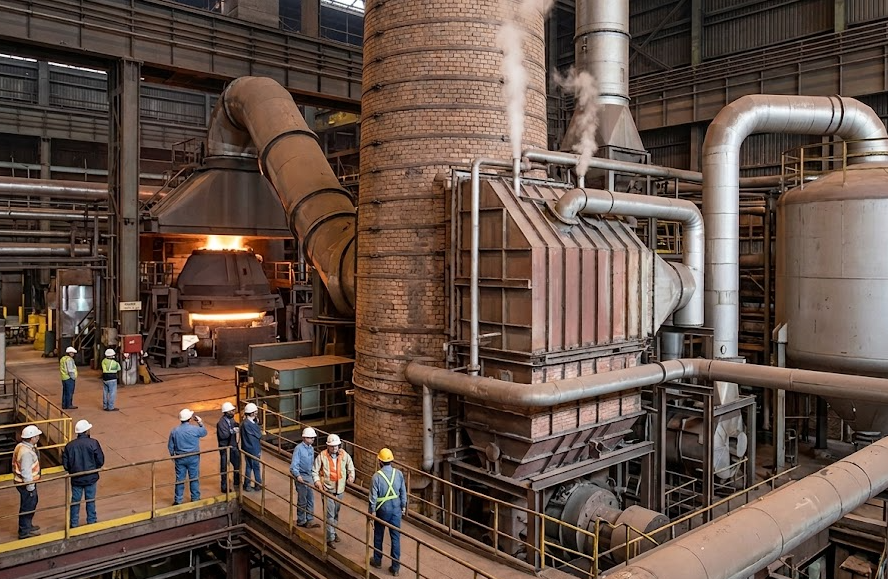
Converter off-gas presents unique challenges that distinguish it from conventional industrial waste heat sources. During the blow cycle, the gas composition transitions dynamically: initial phases produce CO-rich gas (60–80% CO by volume) suitable for chemical energy recovery, while later phases generate CO₂-dominant gas with reduced calorific value but sustained sensible heat content. The gas carries 80–150 g/Nm³ of iron oxide dust with particle sizes ranging from submicron fume to millimeter-scale slag fragments. Temperature fluctuations of 200–300°C within seconds are common during lance position changes or slag foaming events.
These characteristics render standard heat recovery equipment—shell-and-tube exchangers, economizers, or conventional waste heat boilers—unsuitable for direct application. Fouling, erosion, thermal shock cracking, and combustible gas safety management require purpose-engineered solutions that generalist boiler manufacturers cannot provide.
Hailu Heavy Industry addresses these challenges through converter flue gas waste heat utilization systems designed specifically for the thermodynamic and particulate loading profiles of BOF operations.
The company's waste heat utilization for steel converter flue gas systems employ a multi-stage thermal extraction strategy that maximizes energy recovery while ensuring operational safety and environmental compliance.
● Primary Evaporation Cooling Chamber: Rather than conventional water quenching that destroys thermal energy, Hailu Heavy Industry's primary stage utilizes controlled evaporative cooling within a refractory-lined chamber. Atomized water injection reduces gas temperature from 1,600°C to 900–1,000°C while generating saturated steam at 1.0–1.6 MPa. The controlled cooling rate prevents thermal shock damage to downstream equipment while capturing the highest-grade thermal energy in the steam cycle.
● Dust Removal and Gas Conditioning: The partially cooled gas passes through cyclone separators and venturi scrubbers that remove >99% of particulate matter to <50 mg/Nm³. This conditioning is essential before heat exchanger contact: uncontrolled dust loading causes rapid fouling, erosion, and corrosion that would degrade conventional tube bundles within weeks.
● Waste Heat Boiler with Specialized Tube Geometry: The conditioned gas enters a fire-tube or water-tube waste heat boiler engineered for converter service. Hailu Heavy Industry specifies finned tubes with optimized pitch-to-height ratios that maximize heat transfer coefficients while minimizing ash accumulation. Tube materials—typically SA-213 T12 or T22 alloy steel for high-temperature zones, with Inconel cladding in severe corrosion regions—are selected based on gas composition analysis and expected duty cycle.
● Steam Integration: Generated steam—typically 1.0–2.5 MPa saturated or slightly superheated—is integrated into the plant steam distribution network. For facilities without immediate steam demand, Hailu Heavy Industry provides organic Rankine cycle (ORC) power generation modules that convert steam thermal energy into electricity at 15–20% thermal efficiency, or absorption chilling systems that produce process cooling.
The economic viability of steel converter flue gas waste heat utilization depends on recovery efficiency, capital investment, and operational reliability. Hailu Heavy Industry's reference installations demonstrate performance metrics that justify project financing under current energy pricing scenarios.
For a typical 200-ton BOF shop operating 330 days annually:
● Flue Gas Volume: ~120,000 Nm³/h average during blow
● Recoverable Thermal Energy: ~45–55 MW thermal equivalent
● Steam Generation: 60–80 t/h at 1.6 MPa
● Annual Energy Recovery: 350,000–450,000 GJ
● Equivalent Coal Substitution: 12,000–15,000 tons standard coal equivalent
● CO₂ Emission Reduction: 30,000–40,000 tons annually
At prevailing energy prices, these recovery rates generate annual savings of $3–5 million per converter, achieving project payback periods of 3–4 years for greenfield installations and 4–5 years for retrofit projects. Under China's national carbon trading scheme, additional revenue from certified emission reductions further improves project economics.
Converter flue gas contains substantial CO concentrations that present explosion hazards if mixed with air in flammable proportions. Hailu Heavy Industry's waste heat utilization for steel converter flue gas systems incorporate comprehensive safety engineering:
● Nitrogen Purging Systems: Automated nitrogen injection maintains inert atmosphere in all equipment during startup, shutdown, and emergency conditions.
● Gas Composition Monitoring: Continuous infrared analyzers monitor CO, CO₂, O₂, and H₂ concentrations with alarm and interlock functions that trigger protective actions before flammable mixtures form.
● Explosion Relief Design: All pressure-containing vessels incorporate rupture disks and explosion vents sized per NFPA 68 standards, with relief discharge directed to safe locations.
● Emergency Dump Capability: Automated diverters route gas to the existing atmospheric vent system if heat recovery equipment requires isolation, ensuring converter operation continuity.
These safety systems are designed to SIL 2 (Safety Integrity Level 2) per IEC 61511, providing the reliability assurance that plant insurers and regulatory authorities require.
Modern steelmaking operates under stringent emission limits that extend beyond CO₂ to encompass particulate matter, SO₂, NOₓ, and heavy metals. Hailu Heavy Industry's converter flue gas waste heat recovery systems integrate environmental controls that transform regulatory compliance from a cost burden into a competitive credential.
● Integrated Desulfurization: For high-sulfur operations, wet limestone-gypsum or seawater FGD systems reduce SO₂ emissions to <35 mg/Nm³, meeting China's Ultra-Low Emission standards.
● Denitrification: Selective catalytic reduction (SCR) or selective non-catalytic reduction (SNCR) systems address NOₓ emissions, with SCR achieving >90% removal efficiency when installed downstream of dust removal.
● Dust Capture Enhancement: The conditioning and cooling process improves electrostatic precipitator or bag filter performance on downstream gas treatment, reducing overall particulate emissions to <10 mg/Nm³.
By integrating these environmental controls with the thermal recovery system, Hailu Heavy Industry delivers a unified solution that addresses both energy efficiency and emission compliance objectives.
A significant portion of waste heat utilization for steel converter flue gas projects involves retrofitting existing BOF shops where the original design did not anticipate energy recovery. Hailu Heavy Industry's engineering team specializes in retrofit integration that minimizes production disruption:
● Space-Constrained Layouts: Compact modular designs that fit within existing plant footprints without major structural modifications.
● Production Continuity: Phased installation during scheduled maintenance outages, with temporary bypass systems maintaining atmospheric vent capability throughout construction.
● Existing Equipment Integration: Seamless connection to existing gas cleaning, steam distribution, and electrical infrastructure without wholesale system replacement.
● Performance Guarantees: Contractual energy recovery and emission performance warranties that align project financing with verified outcomes.
The transformation of steel converter flue gas waste heat utilization from environmental compliance expenditure to profit-generating energy asset represents one of the most compelling investment opportunities in modern steelmaking. Hailu Heavy Industry's integrated engineering approach—combining thermodynamic optimization, materials science expertise, safety system design, and environmental control integration—enables steel producers to capture this opportunity with quantified returns and managed risk.
For plant managers, energy directors, and sustainability officers evaluating converter flue gas waste heat recovery investments, the analysis should extend beyond simple payback calculations to encompass carbon credit revenue, energy security benefits, regulatory compliance risk mitigation, and corporate ESG positioning. In each dimension, Hailu Heavy Industry's project delivery capability provides the technical foundation for converting thermal waste into strategic advantage.