


Stock Code
002255




In chemical processing, petrochemicals, fertilizers, specialty chemicals, energy, and other demanding industries, a reactor is much more than a fabricated vessel. It serves as the pressure boundary, reaction chamber, heat-transfer platform, and mechanical interface at the center of production. As pressure, temperature, corrosion, agitation, and cyclic loading increase, fabrication quality becomes directly connected to equipment reliability and lifecycle cost.
For companies looking for a heavy duty reactor fabrication supplier, the key question is not simply whether a manufacturer can build a large vessel. The more important issue is whether the supplier can convert process requirements into a mechanically reliable reactor through appropriate material selection, welding, dimensional control, inspection, and documentation.
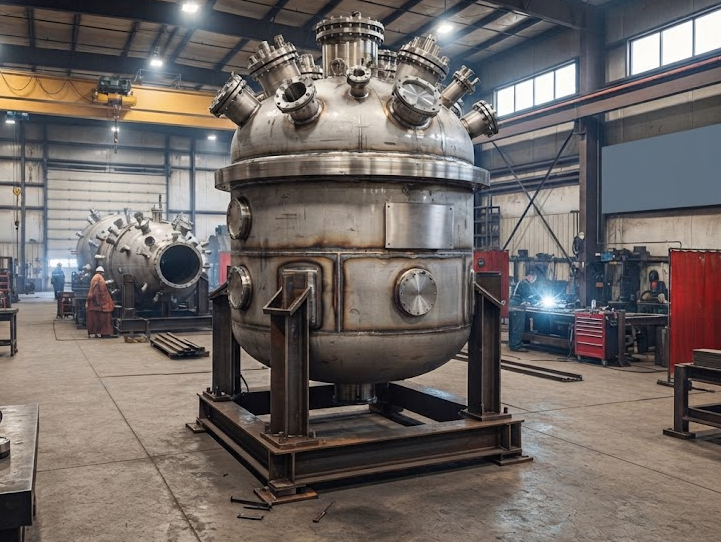
Reliable reactor fabrication starts with process engineering.
Before manufacturing, engineers should establish design pressure and temperature, operating conditions, process chemistry, corrosion mechanisms, reaction characteristics, agitation requirements, heating or cooling duty, and expected pressure or thermal cycles.
Cyclic operation deserves particular attention. Frequent startup and shutdown can generate fatigue stresses even when operating pressure remains within the nominal design range. Nozzles, manways, supports, jacket connections, and welded transitions may become localized stress concentration areas.
For code-compliant pressure equipment, ASME Section VIII is commonly used as a design framework, while additional standards may apply according to the equipment, industry, and project requirements.
A qualified heavy duty reactor fabrication supplier should understand that material selection is a process engineering decision, not simply a purchasing choice.
Carbon steel can be suitable for compatible non-corrosive services, while stainless steel, duplex stainless steel, and nickel-based alloys may be required for increasingly aggressive chemical environments. Clad construction can also combine structural strength with corrosion-resistant process-side protection.
Material selection should consider:
● Process chemistry and contaminants
● Design and operating temperature
● Pressure and mechanical loads
● Corrosion and erosion allowance
● Welding compatibility
● Thermal expansion
● Cleaning requirements
● Expected service life
Using a more expensive alloy does not automatically guarantee better performance. The material must match the actual operating environment and fabrication method.
In heavy-duty reactor manufacturing, welding quality directly affects pressure-boundary integrity.
Qualified welding procedures should be established for the applicable materials, thicknesses, and joint configurations. Preheating, interpass temperature, filler metals, welding parameters, distortion control, and post-weld heat treatment must be managed according to project and code requirements.
The challenge becomes greater with thick-wall vessels, stainless steel, nickel alloys, or dissimilar-material construction. Differences in thermal expansion and metallurgical behavior can affect both fabrication quality and long-term service performance.
Inspection should therefore extend beyond visual examination. Depending on design and specification requirements, radiographic, ultrasonic, magnetic particle, or liquid penetrant testing may be applied. Material identification and traceability are also important for critical equipment.
Industrial reactors are normally customized around their process requirements. Shell dimensions, heads, nozzles, agitator connections, supports, jackets, coils, and internal components all influence final performance.
Nozzle orientation must match plant piping. Agitator mounting and alignment influence vibration and mechanical loading. Supports must safely transfer equipment and operating loads to the foundation.
Heat-transfer design is equally important. Depending on the process, reactors may use jackets, half-pipe coils, dimple jackets, or internal coils. The selected configuration affects heat-transfer area, thermal response, pressure drop, cleanability, and fabrication complexity.
Thermal expansion should also be considered early. Different expansion rates between the shell, jacket, internal components, and connected piping can generate unwanted stresses if the system is poorly designed.
For customers evaluating heavy duty reactor fabrication suppliers, Hailu Heavy Industry focuses on the relationship between process requirements and fabrication quality.
A reliable reactor should not be treated as a generic pressure vessel. Its construction needs to reflect process chemistry, operating pressure and temperature, material requirements, heat-transfer conditions, mechanical loads, connection layout, and service cycles.
This approach is relevant to customers seeking custom heavy duty reactor fabrication, industrial reactor vessel fabrication, and heavy duty chemical reactor suppliers for demanding production environments.
Ultimately, the value of a reactor is measured by more than its purchase price. Mechanical integrity, process stability, maintainability, documentation, and expected service life are all part of the equipment's true cost.
In modern heavy process industries, the reliability of your core reactor dictates facility uptime and safety margins. By leveraging the advanced engineering capabilities of Hailu Heavy Industry as your trusted heavy duty reactor fabrication supplier, plant operators can eliminate mechanical vulnerabilities, ensure compliance with the toughest global codes, and achieve long-term operational profitability.